Trying to understand why art can offend, and why artists should continue to be free
by: Imelda Cajipe Endaya
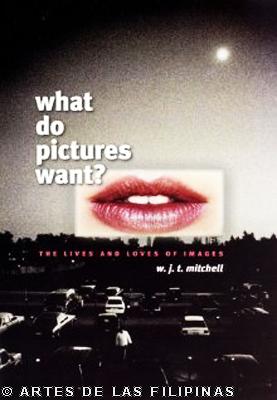
“What in art gives such remarkable power that it can offend? What makes people susceptible to being offended?” Thus spoke Prof. Flaudette May Datuin, taking off from WJT Mitchell’s What Do Pictures Want? I’m glad I attended the UP Arts Studies forum yesterday on the now closed “Kulo” exhibit at CCP. It was such an intelligent, unemotional exchange of facts and ideas on a wide range of offensive art, audience reaction, culture and legalities.
Forum speaker, lawyer and Prof. Alden Lauzon, cited that Article III, Section 4 of the Philippine Constitution pronounces that “[n]o law shall be passed abridging the freedom of speech, of expression, or of the press, or the right of the people peaceably to assemble and petition the government for redress of grievances.” And in an attempt to define the ever-subjective “obscenity,” he quotes: (from Miller vs. California/ cited in Bernas)
“The basic guidelines for the trier of facts must be: (a) whether “the average person, applying contemporary community standards” would find that the work, taken as a whole, appeals to the prurient interest… (b) Whether the work depicts of describes, in a patently offensive way, sexual conduct specifically defined by the applicable state law and (c) whether the work, taken as a whole,lacks serious literary, artistic, political or scientific value.”
The ongoing controversy however is not about an artwork being prurient or obscene but more about blasphemy and sacrilege in a largely “Catholic” populace. Apparently, there are no legal precedents on such matters when it comes to testing our 1987 Constitution of the Philippines. So discussion on this did not ensue. Except I gathered it is best for artists espousing social transformation to test the aesthetics of their art on street folks rather than on May Datuin or Patrick Flores.
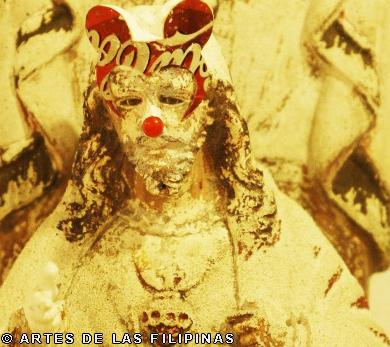
Before the forum, I told Mideo Cruz that I myself was offended specifically by the oversized crimson phallus placed on the crucifix, and the Jesus image with eyes blackened with dripping ink. The stretched condom hanging on one side of a crucifix was just as odious, I said. But that I didn’t think CCP should close the exhibit. Politeismo should have been left open for restricted viewing. Datuin said that we should have seized this as a teaching moment. She even asked that the exhibit be reopened for such purpose. I agree, though maybe it can be moved elsewhere on safer grounds of free-thinking academe. Now I think, my neighbors and relatives would ask me the same way as many have asked CCP Chair Emilie Abrera, “Katoliko ka ba?”
Three hours was too short for artists to pursue the analyses. Let me relate our side comments during and after the forum. With choreographer Myra Beltran, former CCP artistic director Nick Tiongson, I looked back at past CCP exhibits. In the 1990s (or earlier?), works far more derisive of Catholic religion by Manuel Ocampo and Jose Legaspi, were exhibited at the CCP. There were many comments and expression of shock, but there was no censorship, no howl for closure of exhibits. Why at this day and age do we have violent reactions from people including those who did not even see the artwork? We tried to see answers by comparing the artwork, their statements, materials, details, and how they were produced. Myra pointed out that Ocampo’s and Legaspi’s works were paintings and sculptures; i.e. hand-painted and hand-sculptured by the artists themselves. Mideo Cruz’s is an installation of found objects. These are religious objects bought from local Churches and periphery, the very same objects that the many regular Catholics buy and put up on their private altars. This spelled the plain and simple, but big difference.
“Anong pagkakaiba ng nakikita nila sa jeepney at doon sa Politeismo?” (What’s the difference between what one sees inside jeepneys and in Politeismo?) asked Leo Abaya in a Facebook post. Anyone who rides jeepneys can easily answer this. One would find beside the Holy Family image many anti-women pictures which I myself am easily tempted to efface and destroy but don’t and should not. One would see Christ’s image enthroned; beside or below it would be Robin Padilla’s Trust ad, or a sticker “Ipasa na ang RH bill, now na” among other folk statements masquerading as inanities. Jeepney drivers, macho and profane as they are, light up their Poon; they don’t alter or “vandalize” it. They bedeck the Poon with flowers, not condoms. Most of all they don’t put phalluses on the religious image itself. Plain and simple details, that spell the big difference in jeepney folk aesthetics and in Mideo’s.
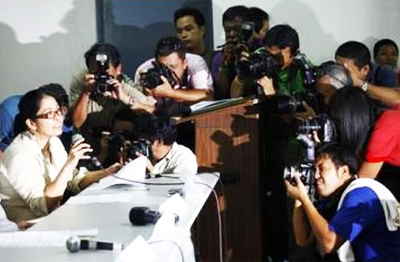
Photo is by Rem Zamora for ABS-CBN
The forum was academic— no emotional banter, no name-calling, no raised voices. Facts of the art, curatorship disseminination, and legal considerations were presented. I learned from CCP Visual Arts Director Karen Flores that the boiling controversy on Kulo erupted when a television program used “Politeismo” as banner story on the RH bill (even if Politeismo is not about the RH bill). The rest of media and religious organizations picked this up, and so that’s how we got into the current Inquisition, or is it West Side Story? From this forum too, we looked at the role of media; it did create this uproar. If media can be more responsible in its reportage, maybe this controversy wouldn’t have erupted.
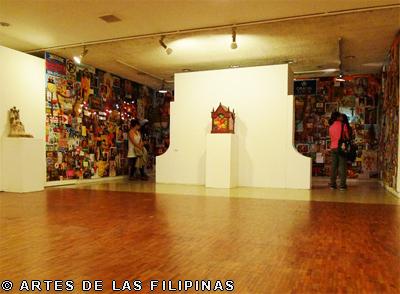
The forum ended with pointers and more questions for us to ponder as the furor dies down. Has it? Or is it aggravating into a counter-culture, anti-artist scenario? While all sorts of politicians have started to grandstand using this art controversy for their own ends, let us look at the positive side of these ensuing events. Yes, artists and cultural workers, let’s seize this as an educating opportunity. This is not just about a controversial artwork, it is about how artists can continue to freely create and exhibit/publish their work, and how government will administer, control or neglect art and culture.